
The Sage Moss Stitch Dishcloth
A free beginner crochet pattern from Hook, Needle & Hoop
This little cloth is one of our favorite "next step" projects. If you can chain and work a single crochet, you already know everything you need. The moss stitch (also called linen stitch) is just single crochets and chains taking turns, and it makes a lovely woven-looking fabric that's firm, scrubby, and lies nice and flat. It works up in an evening or two, and you get a useful thing for your kitchen at the end.
We've written every row out in full, with a stitch count at the end of each one. Take your time, count often, and don't worry about perfection. A slightly wobbly dishcloth still washes dishes beautifully.
A quick note on terms: This pattern uses US crochet terms. Where the UK name is different, you'll see it in brackets, like this: single crochet [UK: double crochet].
At a glance
| Skill level | Beginner |
| Finished size | about 8¼" wide x 8" tall (21 x 20 cm) before the border; about 8¾" x 8½" (22 x 22 cm) with the border |
| Yarn | Worsted weight (#4) cotton [UK: between DK and aran; look for a label that suggests a 5 mm hook] |
| Hook | US H-8 (5.0 mm) [UK: 5 mm] |
| Stitches used | chain, single crochet [UK: double crochet], slip stitch |
Materials
- Main color (MC): sage green worsted weight (#4) 100% cotton, about 80–90 yd (73–82 m). This is an estimate. One standard ball of dishcloth cotton (usually 95–120 yd / 85–110 m) is enough. If your ball holds less than 95 yd, keep a second one handy.
- Contrast color (CC), optional border: terracotta worsted weight (#4) cotton, about 14–16 yd (13–15 m). This is an estimate. A generous leftover is fine.
- Crochet hook: US H-8 (5.0 mm) [UK: 5 mm].
- Yarn needle (tapestry needle), for weaving in ends.
- Scissors.
- Optional: 2 stitch markers, or two scraps of yarn.
Yardage is estimated for a cloth worked at the gauge below. If you crochet more loosely, you may use a little more.
Gauge [UK: tension]
16 stitches and 18 rows = 4" (10 cm) in moss stitch, counting each single crochet and each chain-1 as one stitch.
Gauge isn't critical for a dishcloth. If your cloth comes out a little bigger or smaller, it will still work just fine. If you'd like to check, chain 18 and work 18 rows of the pattern below. Your swatch will have 17 stitches and should measure about 4¼" wide x 4" tall.
Finished size
About 8¼" wide x 8" tall (21 x 20 cm) before the border. With the optional 1-round border, about 8¾" x 8½" (22 x 22 cm). Cotton relaxes a little with use and washing, so these are approximate.
Abbreviations
| Abbreviation | US term | UK term |
|---|---|---|
| ch | chain | chain |
| ch-1 sp | chain-1 space (the little gap under a chain-1) | chain-1 space |
| sc | single crochet | double crochet (dc) |
| sk | skip | miss |
| sl st | slip stitch | slip stitch (ss) |
| st(s) | stitch(es) | stitch(es) |
| rep | repeat | repeat |
| RS / WS | right side / wrong side | right side / wrong side |
| MC / CC | main color / contrast color | main colour / contrast colour |
| * | repeat the steps after the asterisk as instructed |
How the stitch count works
Every row has 33 stitches. In this pattern, each sc counts as 1 stitch and each ch-1 counts as 1 stitch. The ch 1 you make at the start of a row to turn your work (the turning chain) does not count as a stitch.
The rows take turns between two layouts:
- Odd rows (1, 3, 5 ... 35): 17 sc and 16 ch-1 = 33 sts. These rows start and end with a single sc.
- Even rows (2, 4, 6 ... 36): 18 sc and 15 ch-1 = 33 sts. These rows start and end with two sc side by side.
That little difference at the ends is what keeps your edges straight.
Stitch chart
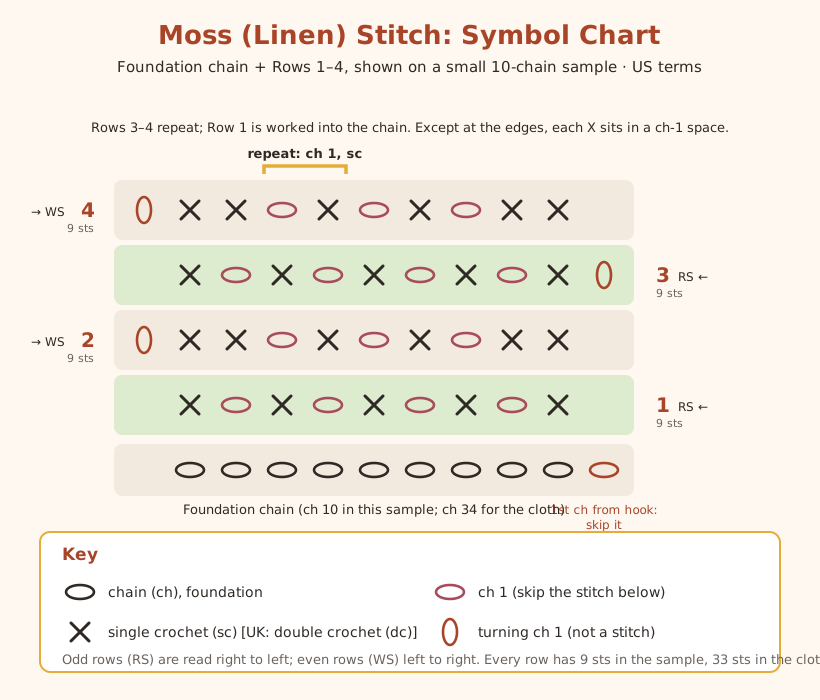
The chart shows a small sample so it's easy to read. Your cloth works exactly the same way, just wider.
Instructions
Foundation
- Foundation chain: With MC, make a slip knot, leaving a 6" (15 cm) tail. Ch 34. [34 ch]
The first two rows
-
Row 1 (RS): Sc in the 2nd ch from the hook (the first ch you skip does not count as a stitch). *Ch 1, sk next ch, sc in next ch; rep from * across to the end. You'll make the "ch 1, sk 1, sc" step 16 times. [33 sts: 17 sc and 16 ch-1]
Tip: place a marker on this side so you know it's the right side.
-
Row 2 (WS): Ch 1 and turn (does not count as a stitch). Sc in the first sc. Sc in the next ch-1 sp. *Ch 1, sk next sc, sc in next ch-1 sp; rep from * until you've used the last ch-1 sp (14 more times; 15 ch-1 made in total). Sc in the last sc. [33 sts: 18 sc and 15 ch-1]
A moss stitch swatch in progress, with the hook (arrow) at the end of a row. See the rows of little gaps between the stitches? Those are the ch-1 spaces. On the next row, push your hook into each gap, not into the chain itself.
The pattern rows
- Row 3 (RS): Ch 1 and turn. Sc in the first sc. *Ch 1, sk next sc, sc in next ch-1 sp; rep from * 14 more times (15 times in all). Ch 1, sk next sc, sc in the last sc. [33 sts: 17 sc and 16 ch-1]
- Row 4 (WS): Work as for Row 2. [33 sts: 18 sc and 15 ch-1]
-
Rows 5–36: Repeat Rows 3 and 4 sixteen more times. Every odd row matches Row 3 and every even row matches Row 4. [33 sts in every row]
You'll finish with 36 rows in total, and the cloth should measure about 8" (20 cm) tall.
-
Fasten off: Cut the yarn, leaving a 6" (15 cm) tail. Pull the tail through the loop on your hook and tug gently to close it.
If you'd like a cloth without a border, skip to Finishing.
Optional border (1 round in terracotta)
A single round of sc in a contrast color frames the cloth and tidies the edges. You'll work all the way around the four sides in one go, then join.
- Join CC: Hold the cloth so the last row you worked (Row 36) runs along the top. Insert your hook in the first st at the top right corner, pull up a loop of terracotta (leave a 6" / 15 cm tail), and ch 1 (does not count as a stitch).
- Top edge: Work 3 sc in that first corner st. Then sc in each st and each ch-1 sp across, stopping before the last st (31 sc). Work 3 sc in the last st (corner). [37 sc so far]
- First side: Turn the cloth a quarter turn so the side is on top. Work 1 sc into the end of each row, from Row 35 down to Row 2 (34 sc). Skip the end of Row 1, because the corner covers it. [71 sc so far]
-
Bottom edge: Turn the cloth so the foundation chain is on top. Work 3 sc in the corner chain (the foundation ch at the base of the end stitch of Row 1). Sc in the base of each foundation ch across, stopping before the chain under the stitch at the other end (31 sc). Work 3 sc in that last corner chain. [108 sc so far]
At one corner you'll see one extra chain sticking out: the one you skipped at the start of Row 1. Leave it alone; the border covers it.
-
Second side: Work 1 sc into the end of each row, from Row 2 up to Row 35 (34 sc). [142 sc]
- Join: Sl st into the first sc of the round. [142 sc] Fasten off, leaving a 6" (15 cm) tail.
Each corner has 3 sc in one stitch. That little bit of extra room lets the corner turn without pulling.
Tips
- Count every row for the first few rows. Count every sc and every ch-1. You're looking for 33. Once the rhythm clicks, you can count every few rows instead.
- Remember the rhythm. On every row after Row 1, the sc goes into a ch-1 space, and the ch-1 goes over the top of a sc. "Chain over sc, sc into the gap."
- Watch the last stitch. The last sc of a row likes to hide under the turning chain. Look for it before you turn.
- Keep your chains the same size as your sc. If your ch-1s are tight, the cloth will pucker.
- Make the foundation chain loosely. A tight chain makes the bottom edge narrower than the rest. If yours is tight, try making the chain with a hook one size bigger (I-9 / 5.5 mm), then switch back.
- Fresh cotton is not stretchy. It can feel stiff on the hook at first. Relax your hands and it gets easier.
Common fixes
- My count is 32 (or 34). Usually it's the last sc of the row being missed (32) or a sc worked into the top of a sc instead of a ch-1 sp (34). Pull out the row and redo it. Taking out one row is quick, and it's much easier than fixing it later.
- My edges are getting wavy or slanting. Check the ends of each row. Odd rows start and end with one sc; even rows start and end with two sc side by side.
- The cloth is getting wider (or narrower) as I go. You've gained or lost stitches somewhere. Count back row by row to find where the count changed, and rip back to there.
- My cloth is curling or feels very stiff. You may be crocheting tightly. Try a 5.5 mm (I-9) hook. Gauge isn't critical here, so do whatever feels comfortable.
- The border is ruffling (or puckering) along the sides. Ruffles mean too many stitches. Pull the side out and skip one row end every 8 rows or so. Puckers mean too few. Work 2 sc into one row end every 8 rows or so. Either way, make sure each corner still gets 3 sc. Your total will be a little different from 142, and that's fine.
- I can't see the ch-1 spaces. Hold your work up to a light, or gently stretch it sideways. The spaces open right up.
Finishing
- Weave in ends. Thread one tail onto your yarn needle. Weave it in and out through the backs of the stitches on the wrong side for about 2" (5 cm). Then turn and weave back the other way for about 1" (2.5 cm). This holds the end in place, even in hot water. Trim close to the fabric. Repeat for each tail (2 for the cloth, plus 2 if you added the border).
- Light blocking (optional). Rinse the cloth or mist it with water, then gently press out the extra water in a towel. Pat it into a square about 8" x 8" (8¾" x 8½" with the border) on a towel, and leave it to dry flat. This evens out the stitches and squares up the corners.
- Care. Cotton dishcloths can go in the washer and dryer. They usually shrink a little the first time, which is normal.
That's it, you made a dishcloth! Make a few more and you'll have a set, or a very nice small gift.
© Hook, Needle & Hoop. This is an original pattern, made with simple, traditional techniques.